Mineral Sand Mining in Sri Lanka: Environmental Crisis and Reality
Published
Mineral Sand Mining in Sri Lanka: Environmental Crisis and Reality
A novel discussion has recently emerged in Sri Lanka regarding the mineral resources along its coastline. Sand containing minerals such as Ilmenite, Rutile, Zircon, Garnet, and Monazite has been identified as an economically valuable resource for the sectors of industry and export. However, the critical question emerging is the impact of extracting these resources on the environment, groundwater, the fisheries industry, tourism, and the lives of coastal communities.
A prominent environmentalist Sajeewa Chamikara who participated as a resource person in a program held on August 21st and 22nd of 2026 for social and environmental activists living in the coastal zones of Sri Lanka's Northern, Eastern and Southern provinces pointed that the attention must be paid not only to the economic benefits of mineral sand mining but also to its hidden environmental and social issues. This article has been prepared based on the facts presented by Sajeewa during the session and field observations by PARL.
1. What is Mineral Sand and How has it been Formed?
Mineral sand found along the Northwestern, Northern, Eastern, and Southern coastal areas of Sri Lanka is the result of a natural geological process spanning millions of years. The rock terrain located in the central highlands and in other mountains of the island is gradually breaking apart over the years due to elements of weather such as rain, flood and wind. Mineral particles found within these rock segments then flow downstream through rivers eventually reaching the ocean.
While in the ocean, these mineral particles are brough back to the coast by waves, currents and coastal sediment movements. Specifically due to the shallow continental shelf in the ocean around Sri Lanka, these minerals tend to reach only the ocean closer to the shore, and are later washed ashore. Because minerals such as Ilmenite, rutile, zircon, garnet, and monazite have a higher density than ordinary quartz sand, hence, when the lighter sand particles are carried away by wind and waves, the heavier mineral particles and sand are deposited on the beach as distinct. Not only does this process deposit minerals along the coast but also these heavy minerals contributes to the stability of the beach.
2. Sri Lanka’s main mineral sand zones and currently active projects
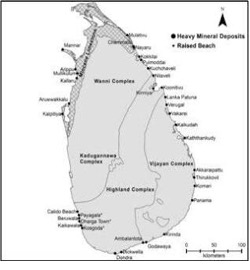
Looking at the distribution of mineral sand deposits in Sri Lanka, it becomes clear how closely they are intertwined with highly sensitive ecosystems, lagoons, freshwater sources, and fishing communities’ livelihoods found around the island. The geographical map below clearly shows how the country’s main mineral sand deposits are spread along the eastern, southeastern, northeastern, and northwestern coastal strips.
Distribution of Islandwide Mineral Sand Deposits
Source: ResearchGate
As depicted in the map above, the heavy mineral particles carried to the ocean through the country’s main river systems are deposited primarily in a few coastal zones.This regional distribution, the projects currently planned, and the environmental impacts arising from them can be examined under three sections, as follows:
(a) Eastern, Southeastern, and Southern Coastal Zone
The coastal stretch extending from Verugal in the Trincomalee District of the Eastern Province through Vakarai in the Batticaloa District, Oluvil, Akkaraipattu, Thirukkovil, Komari, Pottuvil, and Panama in the Ampara District, down through Kumana, Kirinda, and Hambantota in Hambantota District, is a zone made up of highly sensitive and valuable mineral sand deposits. Behind the formation of these ecosystems lies a natural geological process spanning millions of years. These unique ecosystems have been formed by silt and heavy mineral particles, brought down by major river systems such as the Heda Oya,Kumbukkan Oya,Menik Ganga and Kirindi Oya that originate in the central highlands, being deposited along the coastal belt by sea waves and currents.
Accordingly, large-scale mineral extraction projects are currently planned for these areas with the aim of obtaining the minerals found there. In line with this Capital Metals (Taprobane Minerals Project), a British investment company, has obtained exploration licenses for large-scale mineral sand extraction along the eastern coastal strip from Oluvil and Komari to Akkaraipattu. Under this project plan, a Wet Plant (wet processing machinery) to be set up near the excavation site will use water to remove ordinary sand and separate out the heavy minerals (HMC - Heavy Mineral Concentrate). The HMC stock is then to be transported to a Dry Plant proposed to be built near the Oluvil port, where minerals such as ilmenite, rutile and zircon are planned to be separated individually and exported.
However, such large-scale mining operations could have an immense impact on the environment of this region and on the lives of the people who live in these areas. The destruction of the natural protective sand dunes along the coastal strip through this mining could intensify coastal erosion, and the destruction of coastal lagoons and mangrove systems could also cause a rapid decline in fish populations in the shallow sea. As a result, this would lead to the complete collapse of the traditional livelihoods of local fishing communities. In addition, as the natural sand layers are removed, seawater flowing inland creates a serious risk of saltwater mixing into the area's underground freshwater sources.
Furthermore, this crisis is not limited merely to the environment and the fishing industry, but could also impact the rising tourism industry in the region. Through the implementation of this project, it could affect not only the famous Arugam Bay beach strip, which is a world-renowned 'Surfing' sports paradise, but also the beautiful Panama beach area, which is currently attracting both domestic and foreign tourists as an emerging tourist destination. Beach erosion caused by mining, the alteration of wave patterns in shallow seas, and environmental pollution are factors that could cause tourist attraction to disappear from these areas. Ultimately, there is a serious risk that sustainable tourism industry, which brings much-needed foreign exchange to the country, and the future of the local people dependent on it, could be lost in the face of mineral sand mining operations that are intended to begin in this region.
(b) Northeastern Upper Coastal Zone
The coastal stretch spanning from Pulmoddai, Thiriyai, Kokkilai, Nayaru, Muhuththuwaram, Kokkuthoduvai, and Chemmalai connecting the Northern and Eastern provinces is another major mineral sand zone in Sri Lanka. Looking at the historical background, Sri Lanka's oldest and most important mineral sand extraction operation has, for many years, been centred on Pulmoddai. However, as a side effect of that long-running mining, the coasts near local fishing villages such as 'Kallarawa' have been severely eroded, and the dust generated by the transport and processing of mineral sand has also had serious effects on the health of people in the area.
Even though the environmental and social damage caused in the past is still clearly visible, plans are currently being made to expand these mineral sand mining boundaries further across the entire upper coastal strip, from Pulmoddai to Thiriyai, Kokilai, Nayaru, Muhathuvaram, Kokkuthoduvai and Chemmalai.Expanding mining in this uncontrolled manner creates a serious risk that sensitive lagoon systems such as Kokilai and Nayaru, which are the main lifeline of the fishing communities in these areas, could be destroyed entirely. With the fish spawning grounds around these lagoons and the ecosystem connected to them facing destruction, the early signs of a grave crisis, in which the daily livelihoods of fishing communities across the whole region collapse completely, have already appeared.
(c) North-Western and Northern Coastal Zone
The areas around Kalpitiya, Mannar Island and Mandativu that belong to the northwestern and northern coasts of Sri Lanka are regions made up of extremely beautiful and geologically very sensitive ecosystems. Plans are currently being made to carry out large-scale mining projects targeting the mineral sands found in this region.
Most notably an Australian firm named Titanium Sands has drawn up plans for large-scale mineral sand extraction across a highly sensitive coastal stretch covering nearly 140 square kilometers on Mannar Island.
Accordingly, the threat that such large-scale mining and development projects, proposed for island and peninsular lands such as Mannar, Kalpitiya and Mandativu, could pose to the environment and the lives of people in those areas is extremely serious. In particular, Mannar Island is already facing the threat of flooding because of the wind power projects that has been implemented there. The groundwater sources in these areas depend on the balance between saltwater and freshwater that exists between the layers of soil and sand.That ecological balance is been completely broken down because of the excavations carried out internally by these projects. As a direct result, seawater is flowing into the underground water layers of the land, and a crisis has emerged in which the local people's drinking water sources are becoming saline and agricultural farmland is becoming unfit for cultivation.
3. Moving from an Exploration License to a Mining License
Another issue that needs more attention regarding mineral sand projects is the process of issuing exploration licenses. As environmentalist Sajeewa Chamikara points out, the foremost and only legal purpose of an Exploration License (EL) should be to conduct geological investigations by taking limited soil samples, in order to find out whether minerals are deposited in a particular area. In practice,however, what happens is that local and foreign companies such as Capital Metals, Alchemy Lanka, Titanium Sands, etc. use this exploration license as a shield to pave the way for large-scale mining in the proposed areas.
The most serious problem here is that, at a later stage, these companies act to relax environment protection laws and regulations to suit themselves, using power to influence the state,political connections and or administrative loopholes. This involves bypassing the process of obtaining the formal Environmental Impact Assessment (EIA) reports required under the National Environmental Act, and working to convert these exploration licenses into large-scale commercial mining licenses (Industrial Mining Licenses - IML) while disregarding the strict conditions contained in the EIA reports.
Sajeeva Chamikara further emphasizes that prior to mining in a coastal zone, direct approval from the Coast Conservation Department and a formal environmental study under the Coast Conservation Act No. 57 of 1981 are legally mandatory. However, many of these companies try to obtain approvals by concealing the sensitivity of the coastal environment, the impact on groundwater sources, and the harm to people's livelihoods.
Therefore, prior to any commercial mineral mining project commences:
● Completion of formal Environmental Impact Assessment (EIA), Hydrological and Socio-Economic Assessment (SEA) reports conducted by an independent expert team.
● Making those reports fully open to the public, with transparency, for the public consultation process (Public Participation Process),
● It is essential legal and social responsibility not to convert any exploration permit into a large-scale mining permit until the safety of the people and the environment is ensured.
4. How Mineral Sands Are Obtained and the Factory Process
Two main methods are used in carrying out mineral sand extraction projects.
The first is the open or surface mining method (Open-Cast Mining). Here, the layers of sand and soil on or near the coastal strip are completely dug up and removed using large machinery. This process severely destroys the natural sand dunes (Sand Dunes) and coastal vegetation that protect the coastal system, and the operation of the machinery adds heavy noise and dust pollution to the environment.
The second method is Dredging. In aquatic or marshy environments, specialized dredger machines are used to suck up bulk quantities of sand mixed with water. The dredging process carried out in this way poses a deadly threat to the fish spawning grounds and the survival of small aquatic organisms in lagoon, mangrove and wetland systems.
Beyond this, the most serious and least visible threat to the environment during the factory process is the excessive extraction of groundwater. The sand washing and mineral separation process in the Wet Plant requires an enormous volume of water, amounting to millions of liters per day.
Due to the excessive extraction of groundwater sources in the area for these projects, the rapid decline in the natural groundwater level creates a highly risky situation for the livelihoods and drinking water needs of the people in the surrounding areas.
5. Environmental, Social, and Health Crises
The environmental destruction caused by mineral sand extraction is not limited to the land alone; it also has a severe impact on the area’s socio-economic system and on the health of the community. The overall environmental, social and health crisis created by these projects can be identified along several dimensions:
(a) Destruction of Lagoons, Mangroves, and Fishing Livelihoods
Coastal mangrove ecosystems are zones that serve as natural breeding grounds, essential to the survival of aquatic life, including fish. As mineral sand mining destroys these sensitive mangrove and lagoon systems, the natural environment in which fish lay their eggs is completely wiped out. As a direct result, fish catch in the shallow seas and lagoons fall rapidly, and the small scale fishing communities of the area, who own small boats, lose their daily income entirely and reaches a state where their traditional livelihoods collapse completely.
(b) Destruction of Water Sources and Risks of Saltwater Intrusion
The thick layers of sand along the coast are a natural barrier that holds back fresh water and prevents saltwater from mixing with freshwater. By removing these sand layers for mineral extraction breaks the natural freshwater barrier. As a result, seawater mixes with groundwater. This causes saltwater intrusion into drinking wells and agricultural fields, creating a severe water and food crisis in the future.
(c) Coastal Erosion and Health Issues
Natural coastal sand dunes are the primary defense mechanism protecting land from ocean waves. Losing these dunes to mining accelerates coastal erosion, creating a grave threat of land being swallowed by the sea. Additionally, mineral sand processing factories and heavy transport machinery disperse fine dust across the region. Inhaling this dust puts residents, especially young children and the elderly, at risk of respiratory illnesses and long-term health complications.
(d) The Myth of "Refilling"
Although mining companies claim that remaining Quartz sand will be refilled into excavated pits to restore the environment after valuable minerals are extracted, this is an impractical myth. Because sand stripped of heavy minerals is extremely light, it quickly washes away under natural waves and strong winds. Moreover, natural sand layer deposition occurs over millions of years. Therefore, this method of refilling with sand cannot restore the destroyed natural coastal ecosystem or sand dunes to their original condition.
6. Economic Realities and Practical Limitations
During the program an activist raised the question "Can't we strengthen the economy by extracting these minerals sustainably while minimizing environmental damage?" In response Sajeewa Chamikara explained:
“In fact, this is more or less how mineral extraction at Pulmoddai has been carried out. If we try to speed up or increase this process, the whole process could end up failing. The reason is that the value of any mineral or valuable material is determined by how rare it is. If these are mined more and exported more, these minerals become abundant and their value falls. Something like that happened to Sri Lanka's gems.”
As Sajeewa points out, ri Lanka's gem industry went through just such a phenomenon. Because gems were extracted excessively and rapidly and released onto the market, the unique value and high prices that Sri Lankan gems once commanded fell to some extent. The same principal applies to mineral sands. While rapidly mining and exporting raw mineral sand might yield short term foreign exchange but in the long run Sri Lanka itself devalues its own rare mineral wealth.
Also, drawing on an idea that emerged during the discussion regarding value-added production of mineral sands, Sajeewa explained as follows:
“Many countries in the world export minerals without adding value. This is because the value-adding process requires extensive chemical processing, that those factories have to operate under special safety conditions in unpopulated areas, and it takes a freat deal of money and time. Value-added products of this kind are made mainly in large countries such as Australia and South Africa, and the low population on their land has made the process somewhat easier. And even today, the land that was mined in those countries has not been restored to its original condition.”
In the above statement,Sajeewa Chamikara points out that these models used in countries with large land areas and low population density like Australia or South Africa cannot be directly transplanted to a small country like Sri Lanka, which is highly environmentally sensitive and has a high population density.The population has spread all the way right up to coastal areas, alongside livelihoods in fishing, agriculture and tourism. Establishing chemical-intensive processing plants (value-added factories) in such an environment is a serious environmental and health threat to the groundwater, soil and people's lives in the area.
7. People's Rights and Key Questions for Future Decisions
Coastal residents in Sri Lanka are key stakeholders who have relied on and protected these ecosystems for generations. They are also people who have devoted their sweat and labour to the country's development, its food production and its national economy. Therefore, they hold a fundamental Right(right to information) to full Information regarding any large-scale development or extraction project carried out on the land where they live, and about its impact on their environment. That is, information must be provided to the people, with complete transparency and in a way they can clearly understand, about changes in groundwater levels in the area where they live, damage to fish breeding grounds, the technical methods being used, and conditions of the mining licenses granted to the companies concerned.
Further when granting prior approval for any mineral extraction project; state authorities, experts, and the public must rigorously address the following critical questions:
• How does the land where mining takes place affect the coastal zones and groundwater sources?
• Is there a formal plan to protect lagoons, mangroves and fish breeding areas?
• How will chemical waste be managed so that it does not harm the environment?
• Is there a there a compensation mechanism for fishermen and farmers for the losses and income losses caused by mining?
• How great is the long-term environmental and social damage compared with the profits from the project?
• Have the views and objections of residents been truly considered in making decisions about the project?
Conclusion
The natural sand layer guarding Sri Lanka's coastline is not merely a collection of mineral resources to be sold for profit. It is a protective shield surrounding the entire island. It functions as a natural reservoir safeguarding inland freshwater sources, a barrier against coastal erosion, a breeding ground for marine life and a vital lifeline sustaining fishing, farming, and tourism communities.
In the face of short-term economic hardship, recklessly extracting and exporting mineral resources may appear to be an attractive "development solution”. However, if a country has to spend money on restoring its drinking water, domestic food security, community well-being and natural coastal protection that may be lost because of implementing that attractive ‘development solution’, it is neither a profitable nor wise development path to follow. Future generations will have to pay compensation for enormous environmental and social destruction that far exceeds the dollars earned in the short term.
Ultimately, the grave question that remains before us is this:
We have set a price for the minerals extracted from our beaches. But have we placed a price on the water, the fish, the shorelines, and human lives that could be lost as a result?
By Tharindu Milan People's Alliance for Right to Land
Draft based on the presentation and discussion at the workshop for coastal social and environmental activists from the Northern, Eastern and Southern provinces, held on 21-22 August 2026. Resource person: environmentalist Sajeeva Chamikara.
Mineral Sand Mining in Sri Lanka: Environmental Crisis and Reality | PARL | PARL